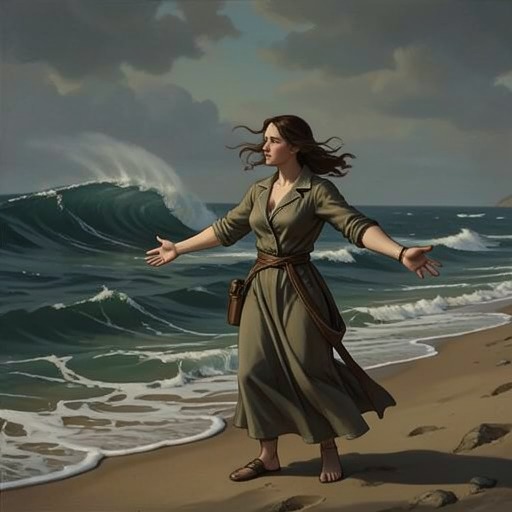
“We walk, until we stop walking.”
The Salt Path“We walk, until we stop walking.” is Ray and Moth’s plainspoken answer to the question of what their plan is. First offered when they have lost their home and cannot yet see a future, it gives their journey a direction without promising an outcome. The words recur in action: walking supplies purpose, routine, and a measure of control, but it also brings exhaustion, enforced movement, and fear of what will happen when the path ends.
A plan without a destination
The phrase takes shape in the woods, after a stranger has questioned whether Ray and Moth have a plan. Ray asks Moth the same question; his reply makes walking itself the plan, while leaving open the possibility that they might find a future along the way. Ray accepts it. The exchange is not a detailed itinerary or a guarantee of safety. Its force lies in giving the couple one immediate, shared action when they cannot yet decide what comes after it.
That need is grounded in the circumstances of their departure. In early August, in Taunton, they stand beside their rucksacks and recognize that they are truly homeless. Unlike travelling with a home to return to, this has no door at the end of the day. They do not want to move from the place where they feel safest, but the plan requires them to set off. A bus to Minehead costs ten pounds each; after the journey’s other expenses, they have fifty pounds left and expect forty-eight pounds a week to be deposited in the bank. Walking is therefore not a detached adventure: it is a way to keep moving when home and financial security are gone.
At the start of the South West Coast Path, the pair delay beside the monument marking the route, taking photographs and adjusting their packs before finally setting out at half past three on a Thursday afternoon. They are excited and afraid, and the walk ahead is 630 miles long. The contrast between this immense distance and the small first step gives the expression its practical scale: it cannot answer the question of where they will end up, but it can tell them what to do next.
The route revises the plan
The path quickly proves more demanding than the guidebook suggests. On a steep zigzag above Minehead, Ray and Moth stop on a bench, look through the branches towards the sea, and reread Paddy Dillon’s description of a route that supposedly drifts a little inland and uphill. The gap between printed directions and the slope under their feet makes walking an encounter with actual terrain, not the simple execution of a map. The plan survives this mismatch because it depends on continuing, not on the path matching expectations.
As the journey proceeds, the body and landscape shape what the words mean. On a hot cliff path, Ray’s legs, hips, and shoulders ache; the sun reflects from the rock, while the height brings both vertigo and exhilaration. Moth leans away from the sea as Ray feels drawn into the open air. Later, the daily rhythm of pain and hunger becomes an ache, then thirst, and finally a steady beat. In this account, walking is not a smooth passage from one destination to another. Fatigue, weather, exposure, and attention to the ground continually alter the experience of moving forward.
The phrase also becomes a way of understanding how repetition can change thought. Ray reflects that each step has its own moment of power or failure, and that climbing out of each combe becomes a victory. The walk does not produce a settled plan for the future so much as a succession of survivable days. Salt wind, dust, and light occupy the mental space that might otherwise be filled with grief and anxiety; repeated movement wears at the sharpness of memory without making the losses disappear.
Choice, interruption, and return
The couple’s movement is never wholly voluntary or wholly forced. At Westward Ho!, they have travelled by bus after a break in the trail. Ray feels as if the bus journey is cheating; arriving disorientated, they feel disconnected from the route. The interruption shows how much the walk has come to organize their sense of purpose: getting from one place to another is not quite the same as making that passage on foot. Their dwindling money and Moth’s need for a beer further locate that unease in the practical pressures of the journey.
At Land’s End, continuing is again a choice made under hardship. After more than 250 miles of pain, exhaustion, hunger, wild nights, and bad weather, a bus could take them back towards the familiarity of Wales. Instead, they sit dripping beneath the visitor-centre archway, put their packs back on, and choose to walk on. They describe the decision as a way of retaining control over their lives and outcomes: they can walk or stop, and they choose to continue. Yet the next night’s circumstances are spare—two sheets of nylon between them and Canada, with only a small amount of food and sweets. Their freedom is real, but it is exercised within poverty and exposure.
At the southernmost point, the route turns north. Ray recognizes that the old home will not be regained and that the future remains uncertain, but the path itself has become a kind of home: a narrow strip of ground that keeps carrying them forward. The change is not a sudden cure for loss. Ray describes a softer acceptance growing through exposure to sun and storms, and a renewed sense of belonging to the elements that does not depend on owning land. The plan’s language of continuing on foot now accommodates a changed relation to home, rather than promising a return to the old one.
What continuing can and cannot promise
When Ray and Moth later resume their journey, the return to open coast brings relief after months of inland confinement. On Ballard Down, they camp above Swanage. Moth, in pain, asks whether they have done the right thing; Ray answers by pointing to the possibility of paying for a room with earned money, Moth’s retraining, and the prospect that Ray may also find work or retrain. The exchange makes explicit what the original plan could only leave open: walking is meant to lead towards a more secure life, but it does not itself guarantee one.
As Plymouth approaches, the path’s dependable rhythm becomes a source of both security and dread. Ray fears the unknown future beyond the route and, more deeply, what will happen to Moth when they have to stop walking and return to ordinary life. Near the city, their plans again encounter practical limits: choices about ferry fares, distance, money, and finding somewhere to camp. When those choices go wrong, Ray feels panic and questions why they never make plans. The expression is therefore not a claim that planning is unnecessary or that walking resolves every crisis. It names the small, shared commitment that remains when plans fail: continue for now, together, until continuing is no longer possible. Its meaning gathers force from that limit as much as from the miles it helps them cross.